





Description
WHAT IS THIS PRODUCT?
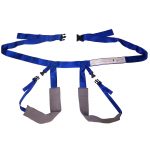
The Chair Belt for Sliders – Front Fastening is a positioning support device designed to help reduce the risk of a person sliding downward from a seated position.
WHO IS THIS PRODUCT SUITABLE FOR?
This product is suitable for people who require seated positioning support but may still move their legs freely, twist, or attempt to stand. When correctly fitted and supervised, the belt is intended to assist in maintaining safe seated positioning and reducing the risk of sliding.
BRIEF INSTRUCTIONS FOR USE
The main lap belt is fitted around the patient and chair and secured at the rear.
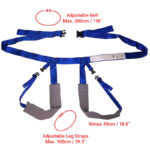
The two padded leg straps are then positioned under the patient’s legs, passed through the waist loops, and wrapped around the chair frame at pelvic level before being buckled in front of the patient near the thigh area. All straps should be adjusted to achieve a secure but comfortable fit.
The belt is suitable for use on larger armchairs. On narrower chairs, excess webbing may need to be wrapped around the frame to achieve a secure pelvic-level position on both sides of the hips.
Appropriate clothing (e.g. trousers rather than loose garments such as dresses) may assist in maintaining correct positioning.
The patient should be regularly monitored while any positioning device is in use. If pressure or discomfort is observed, the device should be adjusted and the patient repositioned.
A rear-fastening alternative is available via the Chair Belt for Sliders – Rear Fastening, which positions the leg strap buckles at the rear to reduce patient access.
WHAT IS THIS PRODUCT MADE FROM?
Webbing, plastic buckles.
GENERAL PUBLIC RESTRAINT OR POSITIONING DEVICE AUTHORISATION LETTER
- If this product is for use in a private home, we require authorisation from a suitable person. This is to ensure it will be used correctly and safely by the family and/or carers, and that using it will not be dangerous. Examples of a suitable person who is able to sign the letter are: Occupational therapist; Physiotherapist; Clinical Nurse Manager; Registered Nurse; Doctor; or another suitably qualified person.
- If this product is for use in a care facility such as a hospital or aged care facility, then this letter is not required, because their staff are already trained in safe restraint use.
- Note: We are unable to sell this product to the USA.
Technical
STOCK KEEPING UNIT (SKU)
412
SIZE
Adjustable Belt – Max. Length 300cm / 118″
Adjustable Leg straps – Max. Length 100cm / 39.3″
WEIGHT
0.4kg / 0.88
GLOBAL MEDICAL DEVICE NUMBER (GMDN)
35305
GLOBAL TRADE ITEM NUMBER (GTIN)
9349145002281
Cleaning
CLEANING METHOD – SEWN VERSION
Machine or hand wash.
MAXIMUM WASHING TEMPERATURE
80°C / 176°F.
DETERGENT
Use a mild detergent. Do not use fabric softener.
DRYING METHOD
Air dry in the shade. Alternatively, tumble dry on a cool temperature and make sure the drum is cool.
CLEANING WARNING
Only use and store the product when it is dry.
Important
Restraints are a prescribed item. Care Facilities such as Hospitals, Nursing Homes, Aged Care Facilities etc., may order this item. For private sales to a family member, written authorisation is needed from a qualified therapist or medical doctor, approving the use of the correct Restraint for the patient’s current condition. Remember if the patient’s condition changes, then a different type of Restraint may be required. It is necessary to ensure the family are aware of the proper use of Restraints, as these can be dangerous if not used correctly.
General Manual Handling Warning: Manual Handling products are designed to assist carers to help patients. They will not make the carer stronger or fitter, but with correct training and use of the products, should make manual handling easier and safer for both staff and patients. When training, practise with an able-bodied colleague. If any procedure is not comfortable or is difficult and puts the carer or patient in a dangerous position, the participants should call out to stop the manoeuvre, recover and recommence. Never jeopardise your health by straining, twisting or being incorrectly positioned when manual handling. Always select the most appropriate equipment for the patient’s current condition and if in doubt, use mechanical equipment. Ask your Manual Handling adviser for individual guidance.
Correct Buckle Threading: Click here to view a video showing the correct way to thread a buckle onto the webbing. It is vital that the buckles on this product are correctly fitted. Contact us if you need to order a replacement buckle if one is broken.
What is the difference between the Front and Rear Fastening belt?
The Front Fastening has the leg buckles at the front within reach of the patient. The Rear Fastening has all buckles at the rear, out of reach of the patient. The Rear Fastening is more popular.
Video
Alternative & Related Products
Chair Belt
Used as positioning device to help a patient in a chair.
AUD $55.00 + 10% US Tariff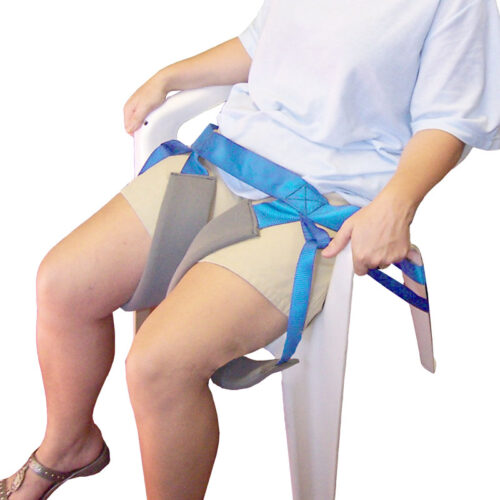

Chair Belt for Sliders – Rear Fastening
Helps prevent people from sliding down chairs to floor.
AUD $79.00 + 10% US Tariff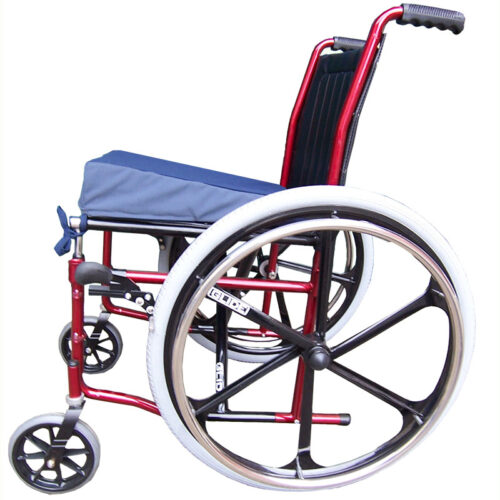

Chair Wedge Anti-Slide
A non-restraint product to help prevent sliding off chairs.
AUD $131.00 + 10% US Tariff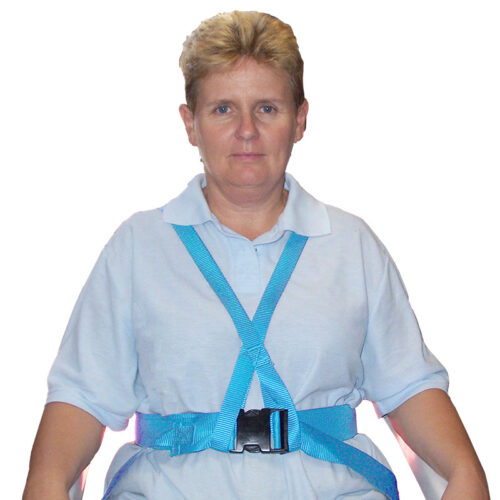

Chair/Lap Belt Shoulder Strap
For use in conjunction Pelican Chair Belt or Lap Belt.
AUD $41.00 + 10% US Tariff

Non-Slide Chair Pad
Helps prevent people from sliding down chairs.
AUD $58.00 + 10% US Tariff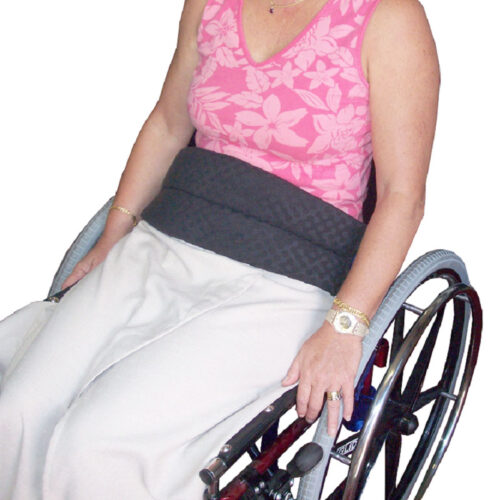

Soft Belt
Wide padded section to provide soft area against body.
AUD $95.00 + 10% US Tariff