















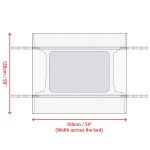


Description
WHAT IS THIS PRODUCT?
The Slide & Turn Hoist Sheet is a great way of getting a hoist to do the turning, rather than the Carer. This is especially beneficial with heavy Patients. This product is an alternative to the Slide & Turn Sheet.
- Remains under a sleeping Patient between turns
- Use a trolley hoist or ceiling hoist to do the turning
- Soft, breathable, slippery material
- Strong tape reinforcing and webbing straps
There are 4 variations:
- Slide & Turn Hoist Sheet; Our standard design with webbing loop attachments. It is sewn in a cylinder so you effectively end up with one slippery sheet on top of another.
- Slide & Turn Hoist Sheet with Keyhole Plates: As above, but with keyhole plate attachments for tilt frame hoists.
- Slide & Turn Hoist Top Sheet: A budget option which is a single sheet only. We recommend using a standard Bed Slide Sheet underneath to get a nice slippery surface. This may not always be necessary depending on the weight of the Patient.
- Slide & Turn Hoist Top Keyhole Sheet: As above, but with keyhole plate attachments for tilt frame hoists.
WHO IS THIS PRODUCT SUITABLE FOR?
This product is suitable for someone who requires turning in bed to help prevent pressure sores.
BRIEF INSTRUCTIONS FOR USE
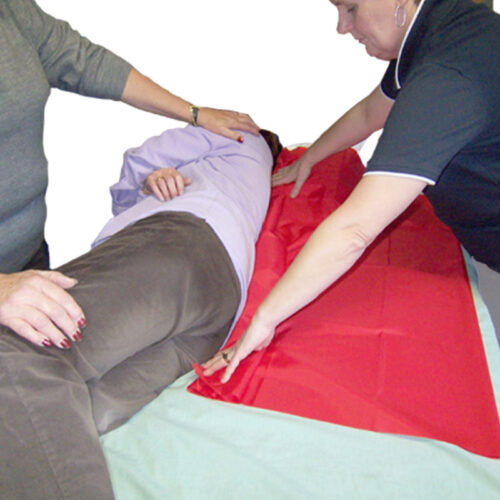
Log roll the person to place the Slide & Turn Hoist Sheet underneath them.
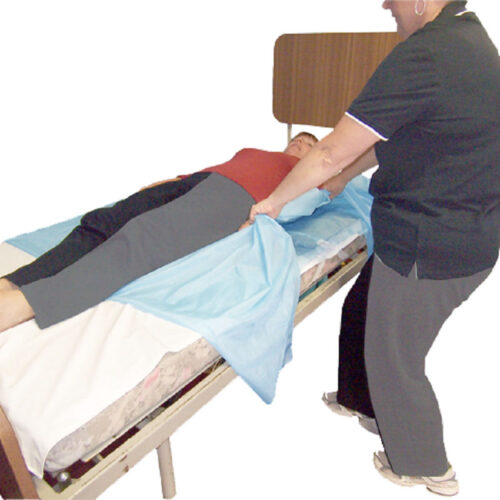
Attach the straps and start to lift. Adjust as necessary to keep the person in the middle of the bed as they turn.
Stop lifting once the person is in the right position, and undo the straps.
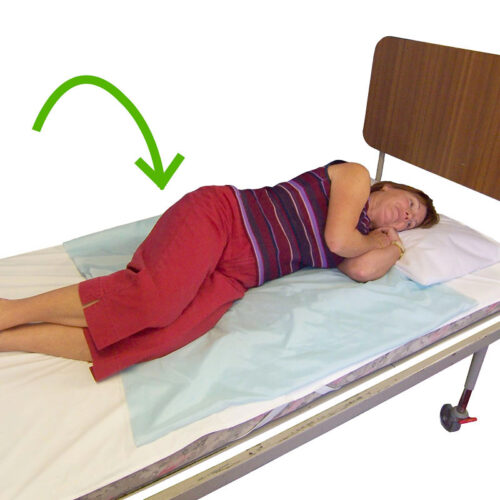
Repeat this process of the other side to turn the back again.
WHAT IS THIS PRODUCT MADE FROM?
Breathable Nylon, Webbing, Foam, Plastic.
Technical
SAFE WORKING LOAD
220kg / 440lbs (In accordance with ISO 10535:2011)
ARTG
99879
GMDN
40535
Sizes
1 size. Special sizes made on request.
 Attachment Method
Metal hook coat hanger type hoists or keyhole plates tilt frame type hoists.
| Item # |
Item Name |
Attachments |
| Item # 509H |
Slide & Turn Hoist Sheet |
Webbing Loops |
| Item # 509HK |
Slide & Turn Hoist Sheet with Keyhole Plates |
Keyhole Plates |
| Item # 509HT |
Slide & Turn Hoist Sheet – Top Sheet Only |
Webbing Loops |
| Item # 509HTK |
Slide & Turn Hoist Sheet – Top Sheet Only with Keyhole Plates |
Keyhole Plates |
Materials Available:
| Material | Photo | Type | Notes |
| All Day Sling Material |  |
Nylon | A strong, thin material with a Rip Stop thread in the material, to help reduce or prevent ripping. |
See the FAQ tab for more information.
Cleaning
CLEANING METHOD – SEWN VERSION
Machine or hand wash .We recommend using a Pelican Washing Bag to help contain the product.
MAXIMUM WASHING TEMPERATURE
80°C / 176°F.
DETERGENT
Use a mild detergent. Do not use fabric softener. Fabric softener and excessive chlorine or bleach can damage any material, including Sling material. Slings should be continuously inspected for deterioration and discolouration, as this may be an early warning of possible failure.
DRYING METHOD
Air dry in the shade. Alternatively, tumble dry on a cool temperature and make sure the drum is cool.
CLEANING WARNING
Only use and store the product when it is dry.
Important
Attaching Brand New Keyhole Plate Slings to a Hoist: View our video guidance here.
General Keyhole Plate Sling Information: Click here for general information, including filing down Keyhole Plates which are too tight. This advice is applicable for the version of this product which uses Keyhole Plates.
Warning: Inspect slings before every use. If any damage is found the Sling must be withdrawn from service and repaired, if possible.
Warning: If you are leaving a sling made in the All Day Sling material under a person, always ensure that there will be no adverse pressure care issues. This includes checking that the attachment method (e.g. webbing loops, keyhole plates, etc.), are not positioned in such a way that may hurt the person. The actual material is very thin and it should not cause a pressure problem, but Patient’s skin integrity should be regularly checked, just in case the sling is causing a pressure problem. If there are any early signs of pressure problems, discontinue using this design of sling.
Disposal: When the Sling is ready for disposal, we suggest the Lifting Straps are cut off, so it cannot be used with another Patient.
Sling & Hoist Compatibility: Click here for more information.
Sling Life Expectancy: Click here for more information.
What the International Standard ISO10535:2011 requires for Period Sling Inspections and Sling Labelling: Click here for more information.
Sling Inspection Before Use Checklist: Click here to download.
6 Monthly Thorough Sling Inspection Checklist: Click here to download.
Online Sling Inspection Training: For excellent guidance on how to do inspections, check out this course on the Udemy learning platform. On completion of the course you will receive a certificate, which makes staff education simple. This training is in addition to the training offered by your organisation. The course covers:
- How the do a Sling Inspection Before Use
- How to do a 6 Monthly Thorough Sling Inspection
- What the labelling requirements are
- Example of sling damage
- How to safely mark a sling
FAQ's
Do I need to do Sling inspections?
Yes – see the Important Information tab for more information.
What are the Sling inspection requirements?
See the Important Information tab for more information. We’ve paraphrased the International Standard 10535:2011 under licence, detailing exactly what is required.
Where can I find the inspection checklists?
See the Important Information tab for more information. We provide the following checklists:
- Sling Inspection Before Use
- 6 Monthly Thorough Sling Inspection